
Join Bicycle NSW today for insurance coverage whilst cycling

When approaching a pedestrian crossing, 'priority path' crossing, children’s crossing or signalised crossing, it can be confusing for bike riders to know what to do.

When riding on a road or on-road bicycle path:

  • bike riders must obey the traffic light signals i.e. stop on red and go on green
  • bike riders must give way to pedestrians at the pedestrian crossing
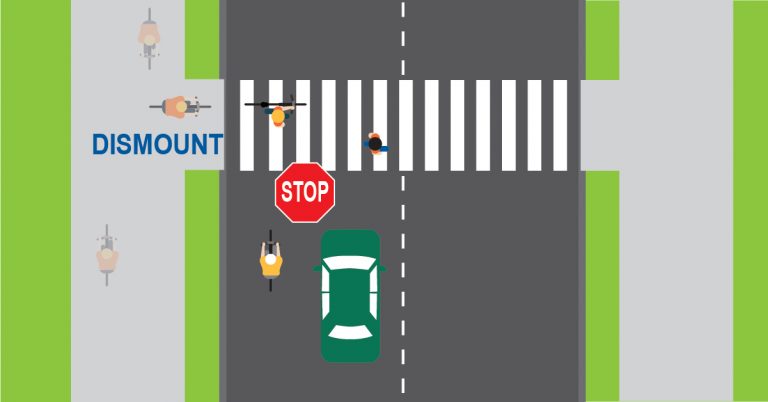
When crossing a road from a shared path, bicycle path or footpath:

  • bike riders can cycle over a ‘priority path’ crossing
  • bike riders can cycle over a signalised crossing if there is a bicycle lantern in the traffic light
  • bike riders must dismount and walk over a signalised crossing (with no bicycle lantern) or a standard zebra crossing. At these crossings, riders who can legally ride on a footpath in NSW must also dismount.

What are ‘priority path’ crossings?

These are combined cycle and pedestrian crossings that do not require bike riders to dismount.

Priority path crossings can be used when bicycle infrastructure – a shared path or dedicated bicycle path – exists on both approaches to the crossing.

In NSW, there is usually a green bicycle path adjacent to the zebra crossing. In some cases, there is a yellow shared user path.

Pedestrians and cyclists are prioritised by requiring all approaching vehicles to give way, in accordance with Road Rule 71. This means a driver or bike rider approaching on the road must ‘slow down and, if necessary, stop to avoid a collision'.

Priority path crossings at Milsons Point, North Sydney Council (left) and Wallsend, City of Newcastle

More about priority path crossings

The NSW Movement and Place website has basic information about priority path crossings.

Australian Standard AS 1742.10:2024 Manual of uniform traffic control devices, Part 10: Pedestrian control and protection sets out detailed requirements for priority path crossings. The yellow shared user crossing is recommended by AS 1742.10 when the crossing serves a shared path, as it allows for a narrower, more space-efficient configuration than placing a green path alongside a zebra.

The yellow crossings are common in Victoria and adopted by City of Newcastle.

However, Transport for NSW does not support the yellow surface treatment. The NSW Supplement to AS 1742.10. includes options for narrow versions of the zebra plus green stripe configuration. This will be more common in NSW in the future.

Priority path crossings are usually raised.  This is expensive but the vertical deflection reduces the speed of vehicles on approach to the crossing and improves driver yielding. Raised crossings also have accessibility benefits by providing an at-grade path across the road, without the need to navigate a ramp and gutter.

Community confusion and concerns

Priority path crossings have sparked confusion and safety concerns in areas where they have been installed. They are a new treatment and there still is no information on NSW Government websites about how to use the crossings, or how they benefit all road users.

Community understanding is further challenged by the many different combinations of signs, lines and colours that councils have used when installing priority path crossings.

Bicycle NSW has urged Transport for NSW to:

  • provide much clearer guidance on standard signage and line marking for engineers and local authorities
  • update the Road Rules to include priority path crossings
  • clarify the rules for all road users in plain English on Transport's own website
  • run a community education campaign on how to use priority path crossings